Win With Willkie!
Every four years, the United States goes to the polls to elect its next president. This election has profound effects on both the nation and the world, as the decisions made by that individual shape nearly every facet of life in the United States.
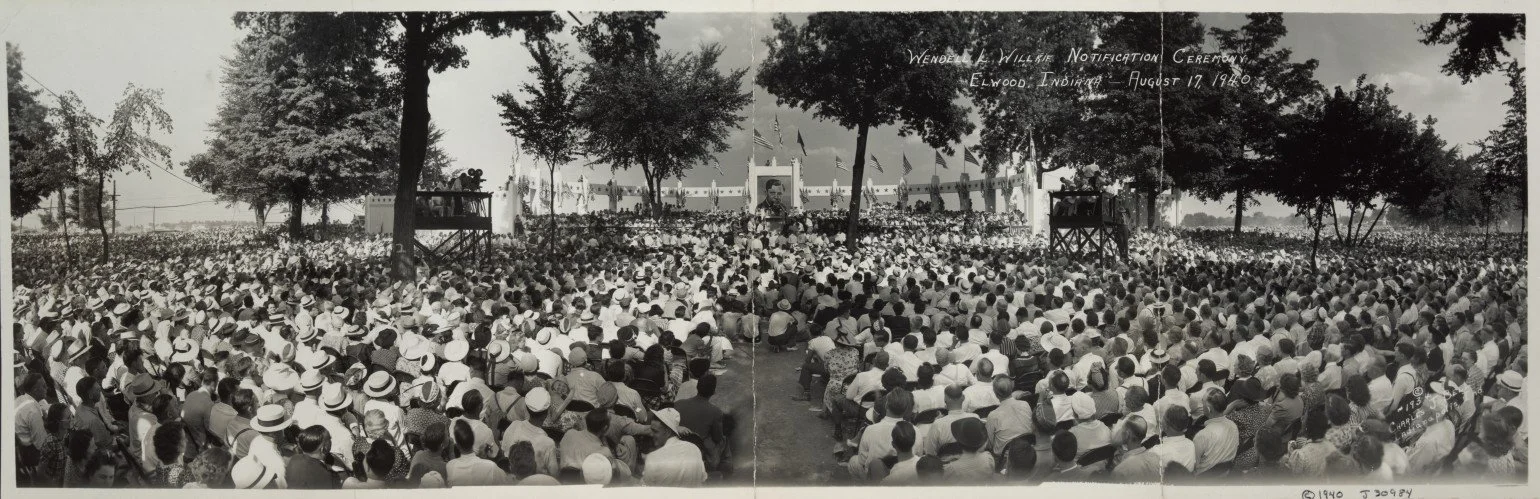
Bell, Charles J., Copyright Claimant. Wendell L. Willkie Notification Ceremony, Elwood, Indiana. United States, Indiana, Elwood, 1940. Photograph.
The 1940 presidential election was unlike any other in the nation’s history. Incumbent Franklin Delano Roosevelt (b. January 30, 1882, in Hyde Park, New York; d. April 12, 1945, in Warm Springs, Georgia) sought an unprecedented third term as president of the United States. Prior to 1940, presidents typically served a maximum of two terms (eight years total), in keeping with the precedent set by George Washington. Roosevelt, however, cited the ongoing economic crisis and war in Europe as reasons to remain in office. Throughout 1940, uncertainty surrounding his decision discouraged other potential candidates from formally declaring their candidacy.
Republicans turned to an unlikely candidate in their effort to win the presidency. The Republican Party nominated Wendell Willkie (b. February 18, 1892, in Elwood, Indiana; d. October 8, 1944, in New York City) as their nominee. Willkie was not a politician and had never held public office, either elected or appointed. However, he had gained national recognition as a business lawyer and later as president of the Commonwealth & Southern Corporation, a utility holding company.
During the 1930s, Willkie used his position to challenge the Tennessee Valley Authority (TVA), one of Roosevelt’s New Deal programs designed to combat the Great Depression and provide affordable electricity to residents of the Tennessee Valley. Although he ultimately lost this battle—while still profiting from the sale of Commonwealth & Southern—his willingness to oppose the federal government brought him national attention. This recognition helped position him as a viable candidate for the Republican Party, though he was far from the overwhelming favorite. His nomination was largely seen as a compromise, as no clear front-runner had emerged to challenge Roosevelt.
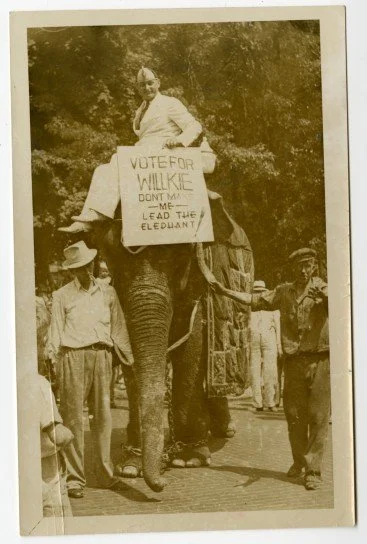
Vote for Willkie parade featuring a man riding an elephant and holding a "Vote for Willkie" sign, 1940, photograph, Minnetrista Heritage Collection.
Who Was Willkie?
Wendell Willkie was born in Elwood, Indiana (primarily in Madison County, with portions extending into Tipton County), the son of two lawyers, Herman Willkie and Henrietta (née Trisch) Willkie. Henrietta was a well-known and respected attorney, having become the first woman admitted to the bar in Indiana. Growing up, the Willkie family often engaged in lively debates around the dinner table, a practice that shaped his skills in argument and public discourse. The Willkies were strong supporters of organized labor and frequently represented labor interests in negotiations with business owners.
Willkie attended Elwood High School and Culver Military Academy before enrolling at Indiana University in Bloomington. While at Indiana University Bloomington, he developed a reputation as an intelligent, if sometimes combative, student who frequently challenged the views of others. Although he openly criticized aspects of the university, he nevertheless earned his degree. Following his time in Bloomington, Willkie joined the U.S. Army and served in Europe near the end of World War I. Even at a young age, he demonstrated an interest in social justice issues and supported efforts to aid America’s allies in times of need.
He later worked as a lawyer for several businesses before becoming counsel—and eventually president—of the Commonwealth & Southern Corporation. During this period, he was a registered Democrat and attended the Democratic National Convention in 1932. However, as Willkie later observed, the policies of Franklin Delano Roosevelt did not align with the ideals of the Democratic Party as he understood them. He subsequently changed his party affiliation, despite not fully agreeing with all aspects of the Republican Party’s platform. Unlike many isolationist Republicans, Willkie believed the United States should assist Britain in its war against Germany.
1940 Election
The 1940 presidential election did not go well for Wendell Willkie. While some voters were concerned about Franklin Delano Roosevelt’s unprecedented third term, that concern was not enough to shift the outcome in Willkie’s favor. Within the Republican Party, Willkie was viewed by many as an unconventional and, for some, unsuitable nominee. He courted the Black vote and spoke against isolationism; however, despite cultivating an image of a “Hoosier farmer” with a rumpled suit and tousled hair, he was widely perceived as a Wall Street corporate lawyer.
On election night, Willkie carried ten states: Colorado, Indiana, Iowa, Kansas, Maine, Michigan, Nebraska, North Dakota, South Dakota, and Vermont. Roosevelt won the remainder of the country. Willkie narrowly carried his home state of Indiana by approximately 25,000 votes (899,466 to 874,063). Roosevelt ultimately won the election with 449 electoral votes to Willkie’s 82.
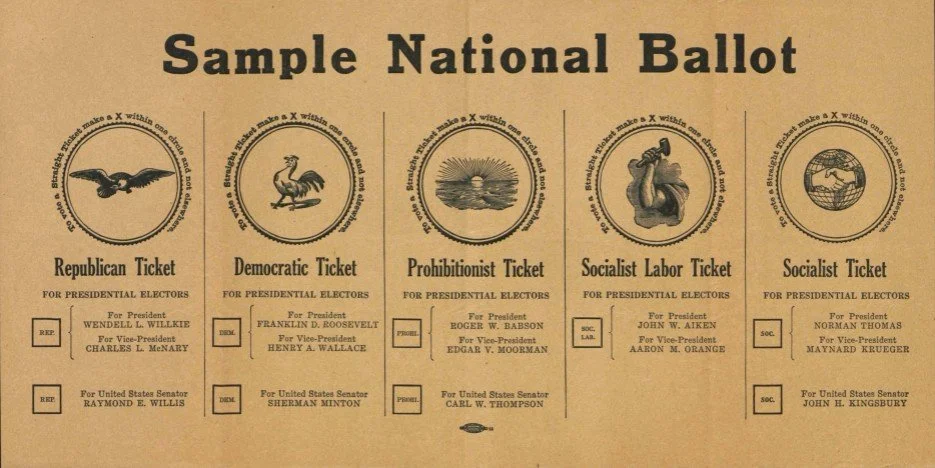
Allied Printing Trades Council. Sample National Ballot, 1940. 1940. Indiana, Marion County, Indianapolis. Indiana Historical Society.
After The Election
Following the 1940 election, Wendell Willkie remained active in public life. He met with Franklin Delano Roosevelt on several occasions. At the time, rumors circulated that Roosevelt was considering Willkie for a role in his administration, including as a potential vice-presidential candidate in the 1944 election. Willkie also traveled abroad on behalf of the Roosevelt administration, and the two even discussed, in passing, the possibility of forming a new political party.
Willkie later sought the Republican nomination for president again in 1944. However, his defeat in 1940, his liberal political views, his relatively recent switch to the Republican Party, and his perceived closeness to Roosevelt made him an unfavorable candidate for much of the party establishment. He entered the primary race but, following a decisive loss in Wisconsin, withdrew and conceded the nomination.
Throughout 1944, Willkie’s health deteriorated. He suffered multiple heart attacks, and a throat infection led to hospitalization in New York City, where he experienced additional cardiac episodes. A final heart attack on October 8, 1944, resulted in his death. Upon news of his passing, newspapers across the country published tributes honoring the former presidential candidate.
Collections
The Heritage Collection at Minnetrista Museum & Gardens tells the story of the Hoosier who nearly became president. Minnetrista is only a 45-minute drive from Elwood, Indiana, Wendell Willkie’s hometown, making it a fitting place to preserve this regional and national story. Political buttons, license plate holders, stuffed animals, photographs of rallies, and other ephemera reflect the enthusiasm surrounding the candidate and his intelligent, affable demeanor, which brought him close to the highest office in the nation.
In addition to the collection at Minnetrista, other institutions help preserve his legacy through artifacts from the 1940 election. The Indiana Historical Society and the Indiana State Museum both hold Willkie-related materials, some of which will be featured at Minnetrista in 2026 in the exhibition America at 250: Celebrating Hoosier Spirit. Willkie’s story is one of many from Indiana that carried national significance. These narratives will be explored in the exhibition commemorating the 250th anniversary of the signing of the Declaration of Independence.
America at 250: Reflections on Community is open to the public from April 4, 2026, through October 25, 2026. Designed as a participatory experience, this exhibition invites guests of all ages to share their own stories and perspectives, becoming part of a larger conversation about identity, belonging, and the future of community in America.